Salesforce Careers and Delivery
Salesforce Job Roles and Their Involvement in Projects
A practical guide to Salesforce project roles, responsibilities, deliverables, collaboration, skills and career direction.
A Salesforce project is completed by a combination of business, functional, technical, testing, release and adoption teams. In a small company, one person may handle multiple roles. In a large implementation, each role may be handled by a dedicated specialist or team.
Common Types of Salesforce Projects
1. New Implementation
Salesforce is introduced for the first time to support sales, service, marketing, commerce or another business function.
2. Enhancement Project
Existing Salesforce functionality is improved with new fields, automation, reports, integrations, agents or user experiences.
3. Support and Maintenance
The team resolves user issues, fixes defects, manages access, improves performance and delivers small change requests.
4. Data Migration
Business data is cleaned, transformed, validated and moved from legacy systems or another Salesforce org.
5. Integration Project
Salesforce is connected with ERP, payment, identity, telephony, data warehouse or other external systems.
6. Agentforce and Data 360
AI agents, grounded data, prompts, actions, identity resolution, segments and activation processes are implemented.
Salesforce Project Lifecycle
01
Discovery and Planning
Understand business goals, current problems, users, systems, budget, timeline and project scope.
Identify project risks, stakeholders, dependencies and success measurements.
02
Requirement Analysis
Conduct workshops and document business processes, user stories, acceptance criteria and reporting needs.
Separate mandatory requirements from future enhancements.
03
Solution Design
Design the data model, security model, automation, integrations, user experience and deployment approach.
Decide where standard configuration is sufficient and where custom development is required.
04
Build and Configuration
Configure Salesforce, develop custom components, build integrations and prepare migration scripts.
Perform unit testing and peer review during development.
05
Testing and Validation
Perform functional, integration, regression, security, data migration and user acceptance testing.
Track defects, retest fixes and confirm that acceptance criteria are satisfied.
06
Deployment and Go-Live
Deploy approved changes, migrate final data, enable users and complete go-live checks.
Keep a rollback plan, deployment checklist and support team ready.
07
Training and User Adoption
Provide role-based training, user guides, demonstrations and support channels.
Measure login activity, feature usage, data quality and business adoption.
08
Production Support and Continuous Improvement
Resolve production issues, monitor integrations and collect enhancement requests.
Deliver improvements through planned releases and ongoing governance.
Discovery → Requirements → Design → Build → Test → Deploy → Train → Support and Improve
Salesforce Job Roles and Project Responsibilities
01Project Sponsor and Business Stakeholders
Senior business representatives who provide direction, funding, decisions and business ownership.
Project Involvement
Define business outcomes, approve budget and confirm project priorities.
Resolve major business conflicts and approve important scope changes.
Support user adoption and executive communication.
Key Deliverables
Business case and success criteria
Budget and scope approvals
Go-live approval
02Product Owner
Owns the product vision and represents business priorities throughout the project.
Project Involvement
Create and prioritize the product backlog.
Clarify requirements and make day-to-day business decisions.
Accept or reject completed user stories based on agreed criteria.
Key Deliverables
Prioritized product backlog
Release priorities
Story acceptance decisions
03Project Manager or Scrum Master
Coordinates delivery, people, schedule, communication, risks and project governance.
Project Involvement
Create the project plan, schedule, milestones and communication process.
Track scope, budget, risks, issues, dependencies and team capacity.
Facilitate status meetings, sprint ceremonies and stakeholder updates.
Key Deliverables
Project plan and release schedule
Risk, issue and dependency logs
Status reports and meeting records
04Salesforce Business Analyst
Acts as the bridge between business stakeholders and the Salesforce delivery team.
Project Involvement
Conduct requirement workshops and understand current business processes.
Document user stories, process maps, acceptance criteria and data requirements.
Support solution validation, UAT preparation and business sign-off.
Key Deliverables
Business requirements document
User stories and acceptance criteria
Process flows, gap analysis and UAT scenarios
Useful Skills: Communication, process mapping, requirements analysis, user stories, data analysis, Salesforce fundamentals and UAT.
05Salesforce Functional Consultant
Translates business requirements into practical Salesforce features and operating processes.
Project Involvement
Lead workshops and recommend standard Salesforce capabilities.
Prepare functional designs for Sales Cloud, Service Cloud, Experience Cloud or other products.
Configure demonstrations, validate solutions and support training.
Key Deliverables
Functional solution design
Configuration decisions and process recommendations
Demo scripts and business validation
Useful Skills: Salesforce product knowledge, process consulting, configuration, demonstrations, documentation and stakeholder management.
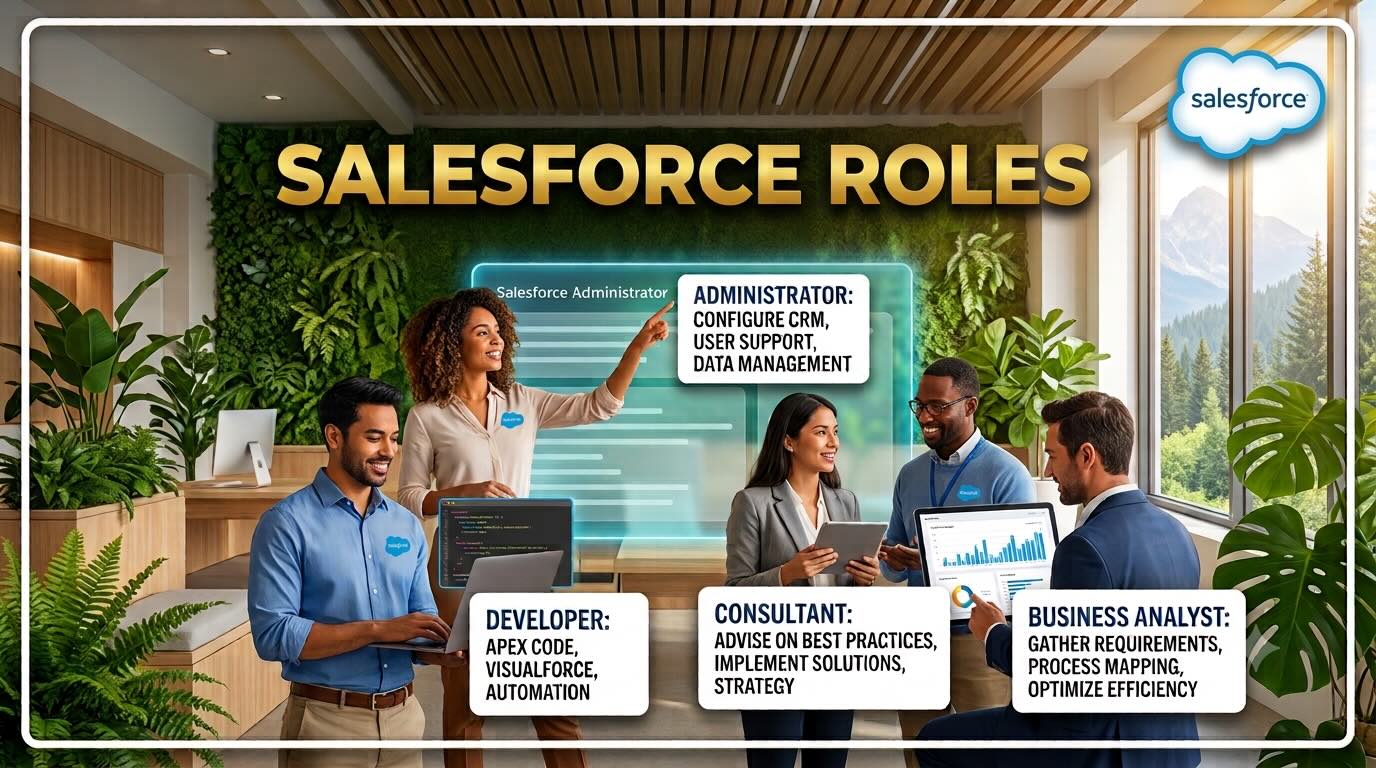
06Salesforce Administrator
Configures, secures, maintains and improves the Salesforce org using declarative tools.
Project Involvement
Configure objects, fields, record types, page layouts, apps and user access.
Build Flow automation, validation rules, reports and dashboards.
Support data quality, sandbox testing, deployment and production administration.
Key Deliverables
Configured Salesforce functionality
Security and access setup
Reports, dashboards and operational support
Useful Skills: Security, data management, Flow, reports, troubleshooting, user support and release awareness.
07Salesforce Developer
Builds custom Salesforce applications, integrations and AI-powered experiences using code.
Project Involvement
Develop Apex classes, triggers, Lightning Web Components and custom services.
Extend standard Salesforce functionality when declarative tools are not sufficient.
Write unit tests, fix defects, review code and support deployment.
Key Deliverables
Apex and Lightning Web Components
Unit tests and technical documentation
Custom APIs, actions and integration logic
Useful Skills: Apex, SOQL, LWC, JavaScript, APIs, security, testing, Git and deployment processes.
08Salesforce Technical Lead
Guides the development team and maintains technical quality across the implementation.
Project Involvement
Break technical designs into development tasks and estimates.
Review code, enforce standards and resolve complex technical problems.
Coordinate developers, integrations, testing and release activities.
Key Deliverables
Technical task plan and estimates
Code-review decisions and development standards
Technical issue resolution
09Salesforce Solution Architect
Designs the end-to-end Salesforce solution so that business processes, products, data and users work together.
Project Involvement
Define the overall solution approach and guide configuration-versus-code decisions.
Design data, security, automation, integration and user-experience patterns.
Review designs for scalability, maintainability, performance and business fit.
Key Deliverables
Solution architecture and design decisions
Data, security and integration approach
Design review and governance guidance
Useful Skills: Multiple Salesforce clouds, platform limits, security, data modelling, integrations, communication and trade-off analysis.
10Salesforce Technical Architect
Owns enterprise-level technical architecture across Salesforce and connected systems.
Project Involvement
Define enterprise architecture, integration patterns, identity, security and non-functional requirements.
Review high-risk technical decisions and guide multiple teams or workstreams.
Ensure the solution is scalable, secure, resilient and aligned with enterprise standards.
Key Deliverables
Enterprise architecture blueprint
Integration, identity and security architecture
Technical governance and risk decisions
11Integration Specialist or Integration Developer
Connects Salesforce with external applications and ensures reliable data exchange.
Project Involvement
Analyze source and target systems, interfaces, volumes and security requirements.
Design and build APIs, middleware flows, platform events or batch integrations.
Handle errors, monitoring, retries, authentication and integration testing.
Key Deliverables
Interface design and field mappings
API or middleware implementation
Error-handling and monitoring design
Useful Skills: REST, SOAP, OAuth, events, middleware, MuleSoft, security, JSON, XML and integration testing.
12Data Migration Specialist
Plans and executes the movement of clean, accurate and complete data into Salesforce.
Project Involvement
Profile source data and define cleansing, transformation and mapping rules.
Perform trial migrations in sandboxes and reconcile record counts and relationships.
Execute final migration, validate results and support business sign-off.
Key Deliverables
Data mapping document
Data cleansing and transformation rules
Migration scripts and reconciliation report
Useful Skills: Data Loader, SQL, Excel, ETL tools, external IDs, relationship mapping, data quality and reconciliation.
13Salesforce QA or Test Engineer
Validates that Salesforce functionality works correctly and satisfies business requirements.
Salesforce does not currently provide a separate role-based Salesforce QA certification. Testers commonly build platform knowledge through Administrator, App Builder, Business Analyst and Developer learning paths.
Project Involvement
Create test plans, scenarios, cases and test data from requirements and acceptance criteria.
Perform functional, regression, integration, permission, migration and end-to-end testing.
Log defects, retest fixes and prepare test-completion reports.
Key Deliverables
Test strategy, plan and test cases
Defect reports and traceability
Test summary and release recommendation
Useful Skills: Salesforce configuration, test design, UAT, API testing, automation testing, security testing and defect management.
14DevOps Engineer or Release Manager
Controls how Salesforce changes move safely and repeatedly across development, testing and production environments.
Project Involvement
Define the branching, version-control, deployment and release-management process.
Coordinate metadata deployments, approvals, validations and production releases.
Maintain deployment evidence, rollback plans and environment consistency.
Key Deliverables
Release calendar and deployment plan
CI/CD pipeline and version-control process
Deployment checklist and rollback plan
Useful Skills: Git, Salesforce CLI, DevOps Center, CI/CD, metadata dependencies, sandboxes and release governance.
15Salesforce UX Designer
Designs clear, accessible and user-friendly Salesforce experiences.
Project Involvement
Research user needs, pain points and common tasks.
Create journey maps, wireframes, prototypes and usability recommendations.
Validate designs with users and improve adoption through simpler experiences.
Key Deliverables
User journeys and personas
Wireframes and prototypes
Usability and accessibility recommendations
16Agentforce Specialist
Designs, configures, tests and optimizes AI agents that work with Salesforce data and business processes.
Project Involvement
Identify suitable agent use cases, users, channels and escalation requirements.
Configure topics, instructions, actions, prompts, grounding and guardrails.
Test responses, monitor quality and improve agent performance after launch.
Key Deliverables
Agent use-case and conversation design
Topics, instructions, actions and prompt templates
Testing, safety and performance-improvement plan
Useful Skills: Agentforce, Prompt Builder, Flow, Apex actions, data grounding, security, testing and responsible AI.
17Data 360 Consultant or Data Specialist
Unifies customer data and makes trusted data available for analytics, activation and Agentforce grounding.
Project Involvement
Design data ingestion, mapping, harmonization and identity-resolution processes.
Create calculated insights, segments, activations and data-governance rules.
Work with architects, marketers, developers and AI teams to provide trusted data.
Key Deliverables
Data-source and data-model design
Identity-resolution and segmentation rules
Activation and monitoring plan
18Trainer, Change Manager or Adoption Lead
Prepares users and the organization to successfully adopt the new Salesforce solution.
Project Involvement
Assess the impact of new processes and features on each user group.
Create communication plans, training materials, demonstrations and user guides.
Track adoption, collect feedback and provide refresher training after go-live.
Key Deliverables
Change and communication plan
Training curriculum, guides and recordings
User-adoption and feedback report
19Salesforce Production Support Engineer
Keeps the live Salesforce environment stable and resolves incidents after implementation.
Project Involvement
Monitor incidents, integrations, automation failures and user-access problems.
Investigate root causes, provide fixes and escalate complex defects.
Manage service requests, known issues, knowledge articles and minor enhancements.
Key Deliverables
Incident and service-request resolution
Root-cause analysis and knowledge articles
System-health and support reports
Role Involvement by Project Phase
| Project Phase |
Primary Roles |
Main Output |
| Discovery |
Sponsor, Product Owner, Project Manager, BA, Consultant, Architect |
Goals, scope, risks and success criteria |
| Requirements |
BA, Product Owner, Consultant, Architect, Admin |
User stories, process maps and acceptance criteria |
| Solution Design |
Consultant, Solution Architect, Technical Architect, Tech Lead, UX Designer |
Functional and technical solution design |
| Build |
Admin, Developer, Integration Specialist, Data Specialist, Agentforce Specialist |
Configured and developed solution |
| Testing |
QA, Developer, Admin, BA, Product Owner and end users |
Test results, defects and business approval |
| Deployment |
Release Manager, Admin, Developer, Tech Lead, Data Specialist |
Production release and migrated data |
| Training and Adoption |
Trainer, Change Manager, Consultant, Admin, Business Champions |
Training, communication and adoption support |
| Production Support |
Support Engineer, Admin, Developer, Integration and Product Teams |
Incident resolution and continuous improvement |
Common Career Progression Examples
Administrator → Senior Administrator → Consultant → Solution Architect
Developer → Senior Developer → Technical Lead → Technical Architect
Business Analyst → Senior Business Analyst → Functional Consultant → Product Owner
QA Engineer → Senior QA → Test Lead → Quality Engineering Manager
Data Specialist → Data 360 Consultant → Data Architect → Enterprise Data Architect
Agentforce Specialist → AI Consultant → AI Solution Architect
Useful Project Documents
Business Documents
Business case, scope, process maps, requirements, user stories and acceptance criteria.
Solution Documents
Solution design, data model, security model, integration design and architecture decisions.
Testing Documents
Test strategy, test cases, defect log, traceability matrix and UAT sign-off.
Release Documents
Deployment plan, release notes, rollback plan, data checklist and post-deployment validation.
Training Documents
User guides, training presentations, recordings, FAQs and quick-reference guides.
Support Documents
Knowledge articles, support model, escalation matrix, known issues and service-level targets.